


Conflicting accounts, absent records cloud details
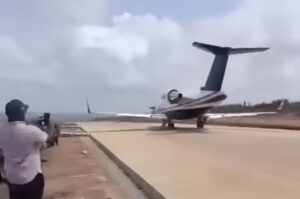
NIGERIAN investigators are still unravelling the details surrounding the Bombardier Challenger 601 business jet’s unintentional landing on a construction road, following an aborted approach to Asaba airport.
Three pilots were in the cockpit of the US-registered jet (N989BC), which was operated by VMO Aero, with one serving solely as an observer.
VMO was operating a flight with a cabin crew member and three passengers, but the Nigerian Safety Investigation Bureau (NSIB) notes that VMO’s permit for non-commercial flights does not authorize fare-paying passenger carriage.
The inquiry into the 10 June incident found discrepancies in pilots’ accounts, no air traffic communication audio, and limited information from flight recorders.
“Data recovered to date [from the recorders] has not yielded sufficient usable information to support a detailed reconstruction of the occurrence,” says the NSIB in preliminary findings.
During take-off preparations, the pilots and observer had disagreements regarding the flight-management system and the planned cruise altitude. The flight from Lagos proceeded uneventfully until the area navigation approach to Asaba’s runway 11.
The captain, on his first flight into the airport, reported that as the jet approached Asaba, its instruments indicated alignment with the published approach. However, due to low clouds, visual contact was intermittent, causing the runway to seem displaced to the right of the track. After performing an orbit, the crew executed a missed approach shortly after receiving landing clearance.
While the tower queried why the go-around occurred, Nigerian Airspace Management Agency (NAMA) provide “no explanation”.
Transcripts from Asaba air traffic control indicate that the tower requested the aircraft’s position multiple times, but received no response. The lack of verbatim audio is due to a malfunction in the voice-recording system, and communications were reconstructed from operational records. The crew later indicated that they re-established the approach to runway 11 within the flight-management system and realigned the jet.
“[The captain] reported that the paved surface ahead appeared consistent with the expected runway environment and aligned with the aircraft’s navigation guidance,” says the inquiry, adding that the tower again gave landing clearance.
Both pilots testified that the observer recognized the paved surface as the runway. However, the observer provided a conflicting account, stating that the aircraft remained in clouds until late in the approach, that the ground-proximity warning system advised to ‘pull up’ to avoid terrain, and that he instructed the captain to abort the landing after spotting a telecom mast ahead.
One passenger expressed concern after overhearing cockpit discussions, questioning if one pilot was in training. The jet landed on a construction road, leading to a debriefing by the captain after the passengers disembarked.
The company’s management was informed about the aircraft’s condition and the crew’s unease about staying on the road. A rescue team arrived 35 minutes later, finding the aircraft undamaged but noting that the passengers were no longer present.
“In contrast, the [two pilots] stated during interviews that no airport rescue or emergency response personnel physically reached the aircraft before it departed the roadway,” it adds.
The first officer said that the aircraft was manually pushed back and turned 180° for take-off after external inspections and an obstacle check along the road. It took off for Lagos 2 hours after landing, arriving 42 minutes later. A subsequent inspection revealed damage to the left nose-wheel assembly.
Investigators have not yet concluded their inquiry, but it emphasizes the need for standardized procedures in aircraft management, inter-agency coordination, technical assessment, and evidence preservation after such incidents.