


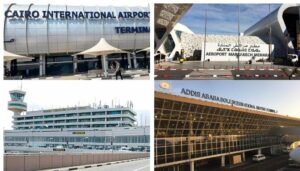
A ranking of Africa’s busiest airports for June 2026 indicated a growing aviation market supported by strong domestic travel demand and capacity growth. South Africa led with 1.5 million seats, while the Republic of Congo experienced the highest growth at 31.3%. Nigeria saw the most significant absolute seat addition of 130,200, a 21.7% increase. In contrast, Kenya’s domestic capacity fell by 18.7%. Ethiopian Airlines maintained leadership with 2 million seats, a 10% rise from the previous year, while Air Algérie and Royal Air Maroc posted growth rates of 11.2% and 10.8%, reflecting continued investments among North African carriers. Based on data from global aviation analytics firm OAG, the top 10 busiest airports in Africa for June, ranked by outbound seats, are:
10. Lagos Murtala Muhammed International Airport
Lagos’ Murtala Muhammed International Airport (LOS) has become one of Africa’s top 10 busiest airports by seat capacity, achieving the highest year-on-year growth rate at 16.7%. Capacity increased from 357,799 in 2025 to 417,622 in 2026, in the period under review, reflecting rising demand for travel. Originally constructed during World War II as Lagos Airport, it was renamed in 1976 to honour former Head of State Murtala Muhammed. The airport has undergone significant upgrades, including the opening of an international terminal in 1979 and the privately funded MMA2 domestic terminal in 2007, solidifying its status as Nigeria’s main aviation hub.
9. Tunis–Carthage International Airport
Tunis–Carthage International Airport (TUN) is Tunisia’s main international gateway and has maintained its status as one of Africa’s busiest airports, recording a 2.7% year-on-year increase in airline seat capacity, reaching 422,531 seats in June. This growth reflects stable air travel demand and emphasizes Tunis’s role as a vital aviation hub linking North Africa with Europe, the Middle East, and other African regions. The airport, located in the capital city of Tunis, serves as the primary hub for several airlines, including Tunisair and Nouvelair, and has been instrumental in the country’s aviation sector for decades.
8. Jomo Kenyatta International Airport
Jomo Kenyatta International Airport (NBO) is Kenya’s largest airport and ranked eighth in Africa by seat capacity, with a 5.1% increase in airline seats in June compared to 2025. The airport serves as a crucial link for East Africa to Europe, the Middle East, Asia, and the Americas, catering to over 50 countries. In 2024, it handled over 9 million passengers and 364,000 tonnes of cargo, serving as a key hub for Kenya Airways since its naming in 1978 after the first President of Kenya.
7. Marrakech Menara Airport (RAK)
Marrakech Menara Airport (RAK) is Morocco’s second-busiest airport and ranks seventh in Africa by seat capacity, with a 7.5% increase in airline seats to 496,926 compared to the same month in 2025. This growth reflects rising tourism demand and the expansion of Morocco’s aviation sector. Located six kilometers southwest of Marrakech’s city center, the airport is a key hub for over 9.3 million passengers in 2025 and connects to more than 60 international destinations through 30 airlines, particularly strong with Europe as a popular holiday destination.
6. Capetown International Airport
Cape Town International Airport (CPT), South Africa’s second-busiest airport, has seen a 4.1% increase in airline seat capacity, handling 515,746 seats in June compared to 495,627 in the same month of 2025. This growth signifies strong passenger demand and the airport’s role as a key international tourism and business hub. Located 20 kilometers from the central business district, CPT connects to over 31 destinations globally and operates about 228 weekly international flights, enhancing South Africa’s connectivity.
5. Houari Boumediene International Airport
Houari Boumediene International Airport (ALG) in Algeria, the country’s largest and busiest airport, is recognized as the fifth busiest in Africa by seat capacity, handling 532,381 airline seats in June—a 2.6% increase from 518,709 seats in the same period last year. This growth underscores its importance as a key aviation hub in North Africa. Located 17 kilometers southeast of Algiers, the airport has its origins dating back to 1924 and has undergone significant upgrades over the years to support increasing passenger traffic. Terminal 1 facilitates domestic and international flights, while Terminal 2 caters to charter and pilgrimage flights. The notable Terminal 4, opened in 2019, enhanced capacity for up to 10 million passengers annually.
4. Mohammed V International Airport
Mohammed V International Airport (CMN) in Casablanca remains one of Africa’s busiest airports, achieving a 6.1% year-on-year increase in airline seat capacity, totaling 665,922 seats in June. Located in Nouaceur, approximately 30 kilometers south of the city, it is Morocco’s busiest airport and key international gateway, serving over 100 destinations. The airport has two passenger terminals, including the modernized Terminal 1, recognized as one of the most advanced facilities in North Africa.
3. O.R. Tambo International Airport
O.R. Tambo International Airport (JNB), the largest airport in South Africa, is Africa’s third-busiest by seat capacity, with a 2.4% year-on-year increase to 1,066,582 airline seats this month. This growth highlights strong passenger demand and Johannesburg’s status as a key aviation hub. Located in Kempton Park, approximately 23 km from Johannesburg and 46 km from Pretoria, it serves as South Africa’s main international gateway and the hub for South African Airways, connecting to all inhabited continents and acting as the principal access point to sub-Saharan Africa. Renamed in 2006 after anti-apartheid leader Oliver Reginald Tambo, the airport was formerly known as Jan Smuts Airport.
2. Addis Ababa Bole International Airport
Addis Ababa Bole International Airport (ADD) is Ethiopia’s main international gateway and ranks as Africa’s second busiest airport by seat capacity, with 1,135,516 airline seats this month, an 8.9% increase from the previous year. This growth is propelled by Ethiopian Airlines and the airport’s role as a major transit hub, serving destinations across multiple continents and enhancing its status as a vital connection point for international travellers.
1. Cairo International Airport
Cairo International Airport (CAI) in Egypt remains Africa’s busiest airport, offering 1,655,250 seats in 2025, up from 1,592,049 the previous year, reflecting a 4.0% year-on-year growth. As the primary hub for airlines like EgyptAir and Nile Air, it connects Africa with multiple regions globally. The airport handled a record 30.9 million passengers in 2025 and is undergoing infrastructure expansion, including plans for a new Terminal 4 aimed at increasing capacity to over 60 million passengers, reinforcing its status as a key transit hub.