


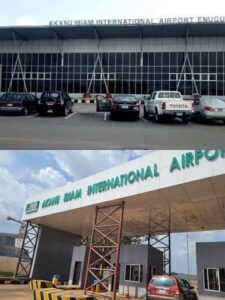
THE Igbo Leaders of Thought (ILT), a group of prominent Igbo intellectuals, traditional rulers and stakeholders, have expressed outrage over the concession of Akanu Ibiam International Airport in Enugu to Aero Alliance. The lengthy and controversial process faced resistance from aviation workers’ unions concerned about job losses and privatization.
A draft agreement in 2025 revealed an 80-year lease, viewed by many as a sale, sparking public and political backlash. Issues regarding the selection process and expected returns on investment prompted calls for transparency.
Ultimately, the Federal Government transferred control to Aero Alliance under a Public-Private Partnership, with promises of job creation and regional economic development.
However, Ndigbo leaders condemned the concession as part of broader regional marginalization, questioning the decision’s fairness as Enugu becomes the only airport transitioning to private management among Nigeria’s international airports.
“As of today, there is currently no active private concessionaire operating any of the other five international airports in Nigeria, namely, Murtala Mohammed International Airport Lagos, Nnamdi Azikiwe International Airport Abuja, Malam Aminu Kano International Airport, Port Harcourt International Airport and Victor Attah International Airport, Uyo. Why should the case of Enugu International Airport, the only international airport in the South East be different?” the group asked.
They warned that withdrawing Federal Government funding could jeopardize the safety, efficiency, and passenger experience at Nigerian airports, as none of the six international airports are profitable without support. A funding cessation, even for a day, might degrade facilities at Enugu International Airport.
Igbo leaders criticized the Federal Government for cancelling the concession bidding for Murtala Mohammed International Airport’s terminal, favouring a N712 billion structural rebuild via the Renewed Hope Infrastructure Development Fund.
“Festus Keyamo claimed during the handover ceremony that there are bidders for the other five international airports. Why did he not wait for the bidding processes to be concluded, so that all the six international airports would be handed over to concessionaires at the same time, why the haste in handing over Enugu International Airport?’ the Igbo leaders asked.
In the 1950s, the Old Eastern Region government established Enugu Airport, which gained international status in 2007 following a N14 billion upgrade under the Yar’Adua and Jonathan administrations, and opened to international flights in 2013. A N10 billion fund for runway rehabilitation and other improvements was approved by President Buhari in 2019, with completion in August 2020.
Concerns were raised by aviation unions about transparency in the concession process and possible ties between the concessionaire and government officials, deeming the transfer as unjust for the South East.
Aviation expert Onyekachi Eze argued that the concession would improve airport operations, increase international traffic, and boost state revenue, while maintaining that federal oversight will remain through relevant aviation authorities and standards.
‘The implication is that as long as it is an airport, the federal government has interest in it, for it to continue to be an international airport, it must continue to comply with the requirements of the NCAA and ICÃO,” Eze said.
He indicated that the concession agreement requires private operators to improve airport services instead of just managing them, noting that Peter Mbah’s administration seeks to transform the airport into a major cargo hub for agricultural exports.
Eze expressed hope that enhanced airport operations will lead Ethiopian Airlines to utilize larger aircraft for the Enugu route. He noted that the airline’s service was adversely affected by the Monday sit-at-home, forcing many travelers to choose airports in Abuja and Lagos. Although Ethiopian Airlines considered retracting from the route, it opted to stay due to substantial passenger numbers from the South-East.
Eze emphasized that increased traffic post-concession could bolster the aviation sector in the region. He reassured that job security for FAAN and aviation agency employees would be maintained under the concession agreement, though some businesses at the airport may need to adjust.
He warned against raising tolls or user fees, which could deter travelers, and criticized customs bottlenecks affecting trade in the South-East, labeling them an “economic conspiracy” against the area.
According to Eze, managing a concession effectively can reduce bottlenecks and enhance economic activity, particularly by boosting Enugu’s internally generated revenue and encouraging airport usage.
He dismissed concerns, citing the successful example of the Murtala Muhammed Airport Terminal 2 and other concessioned infrastructure in Port Harcourt as evidence of the effectiveness of this strategy in improving aviation services. Eze expressed confidence in the project, indicating that the minister’s endorsement reflects optimism about its potential to modernize the airport and increase passenger traffic.
Mr. Titus Agbo, an Aviation Roundtable promoter, stated that the concession of Akanu Ibiam International Airport aims to boost passenger traffic, modernize infrastructure, and attract private investments, enabling operations closer to international standards.
While user charges may increase to recover investments, the resulting improvements and revenue reinvestment are projected to enhance airport facilities and passenger experiences through upgraded technologies like electronic displays and automated check-in. However, the extent of these enhancements will depend on the concession agreement with the Federal Government.
Amidst these developments, Ndigbo leaders expressed concerns over regional marginalization, potential job losses, and safety issues due to privatization.
They demanded clarity on the bidding process and called for continued federal support for the airport, which holds historical significance. Despite criticisms, some aviation experts remain hopeful about the concession’s benefits.