


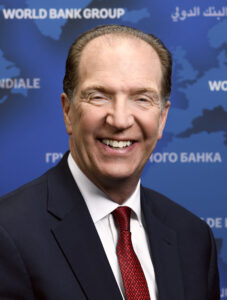
Former President of the World Bank, David Malpass, has raised concerns over Nigeria’s use of collateral-backed borrowing, warning that such transactions could complicate future debt restructuring and undermine efforts to restore debt sustainability.
Malpass, who served as World Bank president between 2019 and 2023, disclosed this in a policy paper published on the World Bank website.
The paper, titled Public Debt and Central Banks, was published as a Policy Research Working Paper following the Stanley Fischer Memorial Lecture delivered by Malpass at the World Bank Group’s Annual Bank Conference on Development Economics 2026.
In the paper, Malpass examined what he described as two major obstacles to development in low-income countries: dysfunctional currency systems and unresolved sovereign debt burdens. Nigeria featured prominently in his assessment of both issues.
On sovereign debt, the former World Bank chief warned that increasingly complex financing arrangements involving collateral-backed loans were making debt restructurings more difficult.
He said, “More recently, private sector transactions to distressed or high-risk sovereigns have become less transparent, sometimes to the point of including non-disclosure clauses, making their benefits to the people of the country unclear and hard to evaluate.”
According to him, “Sophisticated new collateralised transactions – I saw ones in Angola, Nigeria, and Senegal – are creating a new race toward seniority in the capital structure. This will add further complexity to restructurings, as will the expansion of MDB guarantee products. Their sturdiness and value have not been tested in a restructuring context, and I am sceptical they are adding true value.”
Malpass also called for greater transparency in sovereign borrowing, noting that many debt contracts remained opaque. He argued that although many creditors had joined debt reconciliation efforts, “China and some emerging creditors are still not participating. This leaves a giant sector of the debt burden non-transparent and hard to reconcile.”
The former World Bank president criticised existing global debt resolution mechanisms, saying the G20 Common Framework and the Global Sovereign Debt Roundtable had failed to deliver meaningful debt reduction for borrowing countries.
He noted that while the Common Framework had generated extensive engagement among creditors and international institutions, it had achieved little in reducing debt burdens or improving debt transparency.
Malpass said he had proposed the Global Sovereign Debt Roundtable in 2022 to broaden participation in debt restructuring and improve transparency, but the initiative had since lost momentum. “There is no clarity or consensus on the purpose. I have advocated ending both the Common Framework and the GSDR. This would allow space for new processes to be proposed that might be more successful in achieving debt restructurings that benefit development rather than just creditors,” he said.
Beyond debt, Malpass criticised exchange rate policies in several developing countries, including Nigeria, arguing that floating exchange rate regimes and multiple exchange rate systems had worsened poverty.
He wrote that “central banking and IMF policies cause devaluations by advocating floating exchange rates and tolerating multiple exchange rates, primary causes of the impoverishment we see in countries such as Nigeria, Egypt, and Ethiopia.”
He maintained that repeated currency devaluations transfer wealth from low-income earners to those with privileged access to foreign exchange and foreign currency assets. Commenting specifically on Nigeria, Malpass said the country had significant economic potential despite its low-income levels. “Turning to Nigeria, it has per capita income of roughly $1,500 or $4 per day. The median income is less because of the concentration of income and wealth at the top. The upside from currency reform would be massive. Nigerians working outside Nigeria routinely make 10 or 20 times as much,” he said.
He added that the World Bank had attempted to support reforms in Nigeria during his tenure but achieved limited progress. “We embarked on that during my term as President but did not make much progress. I met multiple times with the previous Nigerian President and his cabinet and with the World Bank team,” Malpass said.
According to him, the discussions identified “currency stabilisation and unification, oil sector reforms, tax reform, and agricultural liberalisation, including rice,” as reforms capable of transforming Nigeria’s economy. “These could transform Nigeria’s economy as much as China’s 1993 reforms launched its sustained 10 per cent real growth rate,” he added.
Malpass concluded that current international approaches to debt restructuring and exchange rate management were failing to deliver broad-based economic development. He warned that without reforms to both systems, developing countries would continue to record weak income growth, leaving millions trapped in poverty.