


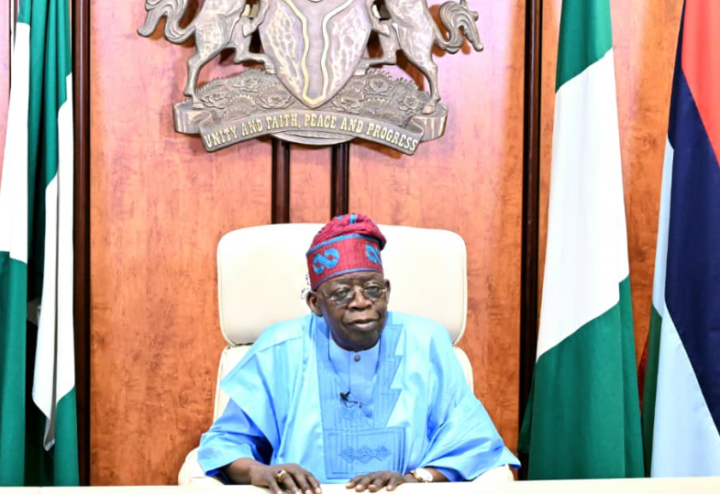
President Bola Tinubu has vowed that no mercy will be shown to terror purveyors who enable the killing and kidnapping of innocent Nigerians.
He also issued an ultimatum to bandits, kidnappers and sponsors of terrorism to surrender or face the full force of the Nigerian state, disclosing that his administration had already neutralised over 13,000 terrorists in the past year alone.
Tinubu gave the warning in his national address delivered on the occasion of the country’s 27th consecutive Democracy Day celebration, his fourth as President since 2023.
According to him, although terror-related deaths had declined by 81 per cent since 2015, Friday’s Democracy Day celebration was subdued by the continued captivity of schoolchildren abducted in Oyo and Borno states.
The Nigerian leader said his administration had moved beyond training with allies to precision operations on the ground.
Tinubu added that despite the neutralisation of terrorists, the door of rehabilitation remained open alongside the door of force.
The N5.41tn security allocation in the 2026 budget, Tinubu said, was a statement of national will to crush the current wave of terrorism, which has raged since 2009.
Beyond the budget, he said his administration had approved the recruitment of more than 50,000 new police officers and thousands of military recruits, which, he revealed, was designed to address the persistent gap between the number of security personnel and the security demands of over 230 million Nigerians.
Tinubu acknowledged that even as the country celebrates 27 years of steady democracy, this year’s festive spirit of Democracy Day was weighed down by the continued hostage situation involving school children and teachers kidnapped in Oyo and Borno states, which has now entered its fourth week.
He called for national unity in the face of the security challenge, rejecting ethnic or religious framing of criminality and urging Nigerians to do the same.
On the intermittent power crisis of the past three years, the President explained the scale of the challenge he inherited and his response so far.
He said by 2023, the sector was “characterised by chronic generation shortfalls, an unreliable gas supply, and transmission infrastructure so fragile that it could not evacuate available power. Distribution companies were burdened by massive losses and a metering deficit of over four million.
“The result was a sector that generated less than the 13,500 megawatts installed capacity, a sector that transmitted less than it generated, distributed less than it transmitted, and collected revenue far below what it needed to sustain itself,” he added.
Tinubu said in response, he signed the Electricity Act, granting states authority to generate, transmit and distribute power, authorised the Presidential Power Sector Task Force to raise a N4tn bond to settle verified legacy debts, and directed the Rural Electrification Agency, supported by the World Bank and the African Development Bank, to deploy off-grid and mini-grid power to underserved communities, universities, markets and hospitals.
He explained, “To address the problems besetting the sector, I signed the Electricity Act, which grants states authority to generate, transmit, and distribute power.
“The Presidential Power Sector Task Force is working hard to reduce the metering deficit. It has also been authorised to raise N4tn bond to settle verified legacy debts.
“The Rural Electrification Agency, supported by the World Bank and the African Development Bank, has deployed off-grid and mini-grid power to underserved communities, universities, markets, and hospitals.
“Electricity is a democratic dividend we owe every Nigerian. We intend to deliver it.”
On the broader economy, Tinubu said federation revenues had risen, providing states and local governments with more resources, fiscal transparency had improved, and investor confidence had returned across agriculture, energy, manufacturing, technology, mining, transportation and the creative industries.
He said non-oil exports grew by 21 per cent last year, over 1,000 small and medium enterprises had been certified for export, and the National Agricultural Development Fund was deploying 10,000 tractors over five years.