


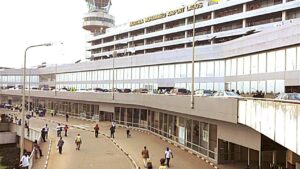
AS the Federal Government allocates N712.26 billion for rebuilding a terminal at Lagos’ Murtala Muhammed International Airport, and transfers the Akanu Ibiam International Airport in Enugu to a private consortium for an 80-year concession, aviation stakeholders are raising concerns about the clarity and coherence of Nigeria’s airport development strategy.
Many infustrexperts argue that the discussion surrounding Nigeria’s 22 federal airports goes beyond the necessary investment. The key issue is the clarity of government funding priorities compared to private investor responsibilities. Recently, the Federal Executive Council allocated N712.26 billion (around $445 million) for the terminal rebuilding at Murtala Muhammed International Airport, Lagos.
On the other hand, the government has concessioned the Akanu Ibiam International Airport in Enugu to a private operator for 80 years, with plans to do the same for Port Harcourt and Kano airports.
Retired Group Captain John Ojikutu, a former commandant of MMIA, is at the centtre of a debate regarding the government’s confusion between aeronautical and non-aeronautical infrastructure.
According to him, aeronautical services like runways, air traffic management, and navigation systems are considered strategic national assets that should be maintained by government agencies such as the Nigerian Airspace Management Agency (NAMA). Conversely, commercial facilities like terminal buildings and shopping areas are deemed non-aeronautical assets that can be developed and operated by the private sector.
“Aeronautical services start from the time the aircraft takes off from the runway and lands back on the runway,” Ojikutu explains, arguing that everything else – the terminal buildings included – is merely a “supporting service” that the government has no business funding directly.
Ojikutu argues that the N712 billion allocated for the reconstruction of the old Lagos terminal should have been financed through a concession instead of public funds, citing historical precedent as the basis for his stance.
He refers to Lagos’s Terminal Two, known as MMA2, which was concessioned to Bi-Courtney Aviation Services following a fire that destroyed the original structure.
“They concessioned it to Babalaki. And they built it from ground zero to that level now,” he recalls, asking pointedly why the government could not simply repeat the model rather than commit public funds.
He also references a 2006 incident where Lufthansa, bidding for a Lagos terminal project, demanded the contract be publicly advertised instead of being awarded discreetly.
“Publish it in the newspaper so that everybody can see,” he claim the airline told officials – a transparency test he suggests the N712 billion project has failed to meet.
Stakeholder skepticism surrounding Nigeria’s aviation projects is widespread, with criticisms focused on the timing, cost, and funding sources of a recent terminal project at MMIA, described by some as a “wasteful venture.”
Analysts highlighted that the approved funding significantly exceeds the aviation ministry’s 2025 budget, and many noted its lack of transparency in approval processes, reminiscent of contentious federal contracts.
While some experts argue that N712 billion is inadequate for international standards, others suggest a concession approach would have been preferable.
In contrast, the concession of Akanu Ibiam International Airport has faced backlash for lacking transparency and adequate consultation with key unions, which outright rejected the agreement with the Aero Alliance Consortium.
In a joint letter, the unions insisted no agreement had ever been signed with them on the matter, so the process was incomplete when the concession was signed, and accused the Ministry of Aviation and Aerospace Development of a “flagrant display of insensitivity” towards staff whose jobs could be affected.
Ojikutu expressed concerns about due diligence, questioning the ministry and the Federal Airports Authority of Nigeria regarding the transparency of the bidding and selection process. He cautioned that unresolved issues, including outstanding Chinese loans related to several international terminals, could lead to the collapse of the Enugu deal, similar to the failed Nigeria Air project.
The disagreement is not confined to organised labour. The coalition of Igbo leaders and community groups questions the decision to single out Enugu for funding withdrawal, highlighting the absence of active private concessionaires at other international airports in Nigeria, including Lagos, Abuja, Kano, Port Harcourt, and Uyo. They express concerns that federal funding cuts could jeopardize safety and passenger experience at the South East facility.
The government aims to ease tensions after talks led by Aviation and Aerospace Development Minister Festus Keyamo, resulting in an agreement to protect workers’ interests while progressing the concession. However, the dispute over the process remains unresolved, with workers previously disrupting airport operations in February.
Ojikutu questions the actual revenue generated from international airlines in Nigeria, estimating that passenger and landing charges alone should yield between $400 to $500 billion from around 10,000 flights, excluding cargo and other fees.
Industry data lends some support to Ojikutu’s frustration with significant disparity in airport economics in Nigeria, with Lagos airport generating the majority of national revenue. In contrast, the sixteen smaller airports, including Enugu, contributed only about N3.6 billion—less than one percent of total revenue. Port Harcourt, important in size and strategy, generated N10.7 billion, roughly 2.8 percent of the total revenue.
Ojikutu argues that the imbalance in airport revenue supports his case for wholesale concessioning, allowing the government to focus its limited resources on essential aeronautical infrastructure, such as radar and navigation aids, which are deteriorating.
The aging radar equipment, noted to be 20 to 30 years old, underscores a critical dilemma in Nigeria’s airport development, particularly with a recent N712 billion investment in reconstructing one terminal while conceding airport control for 80 years.
Ojikutu argues for broader airport concessions, suggesting that this shift would enable the government to focus on essential aeronautical infrastructure. Without a clear demarcation between public investment and private capital, Nigeria’s aviation policy will continue to attract scrutiny from industry stakeholders.