


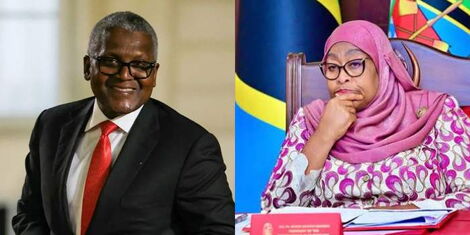
Tanzanian President Samia Suluhu and Africa’s richest man, Aliko Dangote, have agreed to chart a roadmap for a multi-billion-dollar investment push across Tanzania.
The two leaders met at the State House in Dar es Salaam on June 29 to discuss a fresh wave of projects spanning energy, fertiliser, and transport infrastructure.
According to our correspondent, Dangote Industries Limited is eyeing port development, a 2,000-megawatt coal-fired power plant, and a urea fertiliser plant within Tanzanian borders.
There was also talk about a 40-kilometre concrete access road meant to ease congestion around the country’s busy ports.
A plan for a special trade zone was equally on the table, alongside a transport corridor linking Mtwara to Mbamba Bay in the South, an 812-Kilometre stretch that will streamline transport of key raw materials and products across the country.
President Samia moved swiftly after the meeting, directing her Minister of Planning and Investment Kitila Mkumbo to coordinate negotiations, positioning him to lead discussions from the Tanzanian side.
To further seal the deal, a delegation from Dar es Salaam is expected to travel to Nigeria soon to fine-tune the details and map out how the projects will roll out.
Interestingly, this is not Dangote’s first major economic venture in Tanzania, as his Group already runs a Ksh65 billion (USD500 million) cement plant in Mtwara. This singular venture produces three million tonnes of cement annually, serving both local buyers and customers across neighbouring countries.
Dangote also took the opportunity to address why his planned East African oil refinery is heading to Lamu, Kenya, instead of Tanzania. He cited commercial and technical factors behind that, while still inviting the Tanzanian government to buy into the Kenyan refinery project.
The drama traces back to a diplomatic gaffe, after President William Ruto announced the mega-refinery would be built in Tanga, Tanzania, during a Nairobi infrastructure summit, only for President Samia to reveal she’d never approved it.
Amid the resulting rift, Dangote pivoted toward Mombasa instead, citing its deeper port and Kenya’s higher fuel consumption, while leaving the final site decision squarely in Nairobi’s hands.