


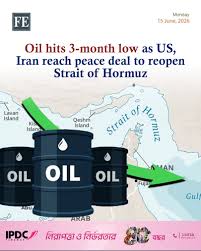
Oil prices have tumbled after the United States and Iran said they had reached a
deal to end their war that will reopen the Strait of Hormuz, sending a wave of
relief through global markets.
The two sides confirmed an announcement from mediator Pakistan, with a
signing ceremony set to take place in Switzerland on June 19, bringing an end
to three months of conflict that has sent energy prices soaring and revived fears
of another inflation spike.
The Strait — a vital maritime chokepoint through which roughly 20 per cent of
the world’s crude oil supply transits — was effectively closed by Tehran soon
after US-Israel strikes on Iran launched the conflict.
“The Deal with the Islamic Republic of Iran is now complete,” US President
Donald Trump wrote on social media Sunday as he marked his 80th birthday.
“I hereby fully authorise the toll-free opening of the Strait of Hormuz,” he
added. “Ships of the World, start your engines. Let the oil flow!”
Iran’s Deputy Foreign Minister Kazem Gharibabadi then said the deal put an
“immediate end” to the war, with talks on a “final agreement” due within two
months.
The content of the agreement, which follows weeks of fraught negotiations and
periodic threats from Trump of fresh hostilities, remained unclear.
Crude prices tanked as much as five per cent on Monday, with West Texas
Intermediate approaching 83.30.
Both main contracts have come down since their initial surge past $`110 soon
after the conflict started.
The sharp drop in oil costs soothed growing concerns that soaring inflation
could force central banks to begin hiking interest rates again.
Data last week showing a jump in US May consumer prices — coupled with
strong job creation — had ramped up bets on the Federal Reserve tightening
before the end of the year.
“Oil down takes the inflation impulse down. Lower inflation risk takes some of
the Fed-hike premium out of the curve. Lower yields give duration and growth
equities room to breathe,” said Stephen Innes at SPI Asset Management.
“The dollar loses a bit of its wartime bid… in one headline chain, the market
moves from bunker pricing to reopening pricing,” he added.
Traders will now have their eye on the next steps, he added, including the
official signing in Switzerland, mine clearance and Israeli restraint.
“While it is certainly good news for the global economy and Asia that a deal has
been announced, whether this sticks and remains viable depends, among other
things, on the details of the negotiated terms,” Wan said.