


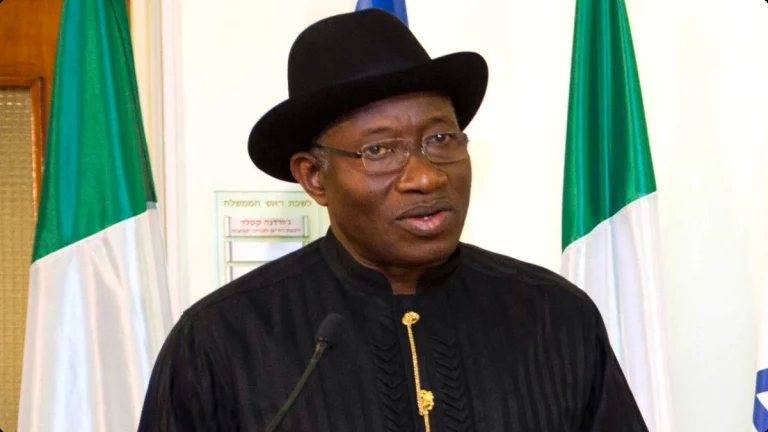
Former President Goodluck Jonathan has credited China’s success in developing a strong domestic oil and gas industry as the inspiration behind Nigeria’s local content policy, while commending the Nigerian Content Development and Monitoring Board (NCDMB) for significantly expanding indigenous participation in the sector.
Speaking yesterday at the SweetCrude Dialogue 2026, tagged: “Through the Python’s Eye: 70 Years of Oil and Gas Production,” as theme held at the Nigerian Content Tower in Yenagoa, Bayelsa State, Jonathan said he remained fulfilled by signing the Nigerian Oil and Gas Industry Content Development (NOGICD) Act into law in April 2010.
He recalled that the idea for the legislation was shaped by a visit to China while serving as Deputy Governor of Bayelsa State, where he observed that virtually every component used in the country’s oil industry was sourced locally.
“Almost everything used in the Chinese oil industry was sourced locally,” Jonathan said, noting that China’s remarkable progress in the petroleum sector followed the discovery of the Daqing Oilfield in 1959—just three years after crude oil was first discovered in Oloibiri, present-day Bayelsa State.
The former president said the contrast between China’s industrial development and Nigeria’s dependence on foreign technology, expertise, equipment and production inputs left a lasting impression on him.
According to Jonathan, the experience reinforced the need for Nigeria to establish a legal framework that would promote local participation, build indigenous capacity and retain greater value from its oil and gas resources.
He praised the NCDMB for delivering on the objectives of the Act and commended the organisers of the dialogue, De Mangrove Conversations, led by Biobele Da-Wariboko, for creating a platform for stakeholders to reflect on the industry’s evolution.
Jonathan also stressed the importance of sustained conversations around host communities and governance challenges, noting that the Petroleum Industry Act (PIA) has made notable progress in addressing some longstanding issues.
Representing the Executive Secretary of the NCDMB, Engr. Felix Omatsola Ogbe, the Board’s Director of Monitoring and Evaluation, Esueme Dan Kikile, described the conference theme as an opportunity to assess the industry’s journey, review achievements and define the future of Nigeria’s energy sector.
He acknowledged Jonathan’s role in establishing the NOGICD Act and the NCDMB, noting that local content participation has increased from less than five per cent in 2010 to 61 per cent in 2026.
According to him, the Board has consistently pursued its mandate of increasing indigenous participation by enforcing local content requirements, building local capacity and ensuring more industry expenditure remains within the Nigerian economy.
He said the Board’s Human Capacity Development Initiative has compelled operators to dedicate resources to training Nigerian engineers, geologists, technicians and seafarers, while its flagship graduate training programmes have created a steady pipeline of industry-ready professionals.
Kikile also highlighted several strategic projects undertaken by the Board, including the 17-storey Nigerian Content Tower in Yenagoa, the Oloibiri Museum and Research Centre, the Nigerian Oil and Gas Park Scheme in Bayelsa and Cross River states, gas processing infrastructure in Gbarain, the Polaku Gas Project, the Brass Shipyard and alignment with the Nigeria LNG Fertiliser Project.
He added that the NCDMB’s Back-to-the-Creek Initiative is helping to extend development opportunities to grassroots communities directly impacted by oil and gas operations.
“By anchoring these transformative initiatives, human capital development and high-level investments, the Board is transitioning the cradle of Nigeria’s oil history from a mere extraction zone into an active centre of commercial, technological and industrial value retention,” he said.
Bayelsa State Governor Douye Diri, represented by Deputy Governor Lawrence Ewhrudjakpo Akpe, said Bayelsa was the appropriate venue for discussions marking 70 years of Nigeria’s petroleum industry, given its historical significance as the birthplace of the country’s oil industry.
He commended De Mangrove Conversations for promoting dialogue on the development of the Niger Delta and Nigeria’s oil and gas sector.
Delta State Governor Sheriff Oborevwori, represented by his Chief of Staff, Johnson Erijo, urged industry stakeholders to renew their commitment to host communities while evaluating the sector’s progress over the past seven decades.
Also speaking, the Managing Director of the Niger Delta Development Commission (NDDC), represented by Chief of Staff Julius Oworibo, said the dialogue provided an opportunity to reflect on the gains recorded in oil-producing communities and identify areas requiring further intervention.
Delivering the keynote address, Professor Ibibia Lucky Worika of the Centre for Advanced Law Research, Rivers State University, said oil had shaped Nigeria’s economy, politics, foreign relations and development over the last 70 years, while also contributing to environmental degradation and conflict in the Niger Delta.
He argued that environmental justice must remain central to future energy policies, describing it as “a constitutional, moral and developmental imperative.”
Earlier, the convener of De Mangrove Conversations, Biobele Da-Wariboko, said the initiative was established to preserve the history and contributions of the Niger Delta to Nigeria’s economic development and prevent them from being overshadowed by political and ethnic divisions.