


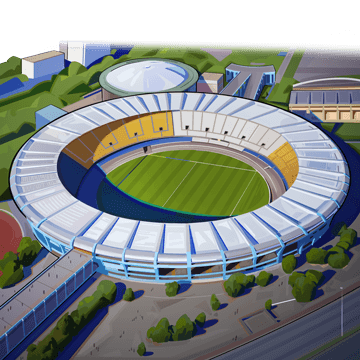
The iconic Estádio do Maracanã in Rio de Janeiro will host both the opening match and final of the 2027 FIFA Women’s World Cup, after FIFA unveiled the full schedule for the tournament in Brazil.
The global football governing body confirmed on Thursday that all 64 matches will be played across eight host cities, with each venue set to stage at least seven matches, including a minimum of one knockout fixture.
Hosts Brazil will open their campaign at the Maracanã on Thursday, June 24, before travelling to São Paulo for their second group match at Arena Itaquera on Tuesday, June 29. They will then play their final group-stage fixture at the Estádio Nacional in Brasília on Sunday, July 4.
Brasília, Porto Alegre, Recife and Salvador will host matches through the Round of 16, while Belo Horizonte and Fortaleza will join Rio de Janeiro and São Paulo as quarter-final venues.
São Paulo will stage one semi-final and the bronze-medal match, while the second semi-final and the final will take place at the Maracanã.
FIFA President Gianni Infantino said the tournament would provide an opportunity to showcase the growth of women’s football while allowing Brazil’s passionate supporters to play a central role.
“We can’t wait to witness a new chapter of women’s football history unfold when the world’s best players, coaches, fans and local communities take centre stage in Brazil next year,” Infantino said.
“I already have goosebumps thinking about the incredible passion, colour and energy that Brazilian fans will bring to the tournament as they welcome the world to eight vibrant host cities.”
FIFA’s Chief Women’s Football Officer, Dame Sarai Bareman, said the schedule had been carefully designed to balance sporting fairness with the desire to involve fans across the country.
She said factors including travel distances and recovery time between matches had been considered in drawing up the schedule for the 32 participating teams.
The Maracanã will make history by becoming only the third stadium to host both a men’s FIFA World Cup final and a FIFA Women’s World Cup final.
It will join Råsunda Stadium in Solna, Sweden, which hosted the 1958 men’s and 1995 women’s finals, and the Rose Bowl in Pasadena, United States, which staged the 1994 men’s and 1999 women’s finals.
Former Brazil women’s captain Aline Pellegrino, who serves as FIFA Women’s World Cup 2027 Executive Director of Legacy and Stakeholder Affairs, said hosting the tournament was a source of immense pride for the country.
“Next year, we will see people from across Brazil and around the world come together to celebrate women’s football in a country renowned for its love of the game,” Pellegrino said.
She added that each host city would bring its own identity to the tournament and help create an atmosphere capable of inspiring the next generation of players.
The schedule is now available on FIFA’s digital platforms, allowing supporters to begin planning their trips to the tournament.
The final version of the schedule will be released after the official tournament draw, which is expected to take place later this year.