


A review of publicly available data by our correspondents reveals that, despite receiving a total of ₦66.7 billion in local government allocations from January 2024 to February 2025, rural schools in the Federal Capital Territory (FCT) continue to face severe neglect, characterised by crumbling infrastructure and substandard learning conditions.
Records from the Office of the Accountant General of the Federation indicate that the six Area Councils in the FCT consistently received monthly disbursements during the 14-month period.
The breakdown includes ₦4.8 billion in January 2024, ₦4.4 billion in February, ₦3.9 billion in March, ₦5.2 billion in April, and ₦3.7 billion in May.
In June, the FCT’s Area Councils received ₦3.6 billion, followed by ₦3.7 billion in July. Allocations rose to ₦4.8 billion in August, while September and October saw disbursements of ₦3.9 billion and ₦4.6 billion, respectively. The final quarter of 2024 recorded sharp increases—₦7.0 billion in November and ₦7.1 billion in December. The upward trend continued into 2025, with ₦4.5 billion allocated in January and ₦5.5 billion in February.
Despite these substantial funds, socio-accountability group MonITng has repeatedly raised the alarm over the deteriorating conditions of public schools in the FCT, where pupils are often forced to learn on bare floors or in unsafe, overcrowded classrooms.
The situation has reportedly forced some students to drop out of school.
In one of its posts, MonITng voiced concern over the deplorable condition of a school located within the Abuja Municipal Area Council (AMAC).
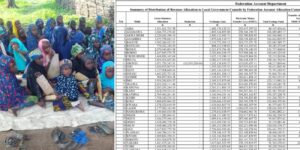
It said, “In LEA Primary School, Gyadna in AMAC, FCT Abuja, what we saw was deeply disturbing. The school is in total disrepair—collapsed roofs, crumbling walls, and broken floors. Pupils are learning in dark, poorly ventilated classrooms with leaking roofs and open ceilings.
“Some blocks have been completely abandoned due to their dangerous state. It’s heartbreaking to see children expected to learn in such inhumane conditions.
“Despite multiple appeals from the community to the Abuja Municipal Area Council, nothing has been done. Parents are losing hope, and children are paying the price. Over 223 pupils have dropped out of school because they cannot continue to learn in such unsafe and degrading conditions.
“Teachers are overwhelmed, and those who remain struggle daily to hold lessons in classrooms that feel more like disaster zones than learning spaces.”
Another school in the Gwagwalada Area Council in Abuja was said to have children learning under a tree.
Our team that visited LEA Nomadic Primary School, Rugan Wakili Buba, Paiko Kore, Gwagwalada, FCT Abuja, said.
“Dozens of children take classes under the shade of a tree, sitting on bare ground with no classrooms, chairs, or learning facilities. This is the harsh reality for children in the heart of the nation’s capital.”
“Despite the billions of naira allocated to education by the FCT Administration, these children have been forgotten. The school has no single building to shelter them. Rain or shine, they are forced to learn in the open, or not at all. During the rainy season, learning stops altogether. Sometimes, kind community members volunteer their homes so these kids can continue their education,” the statement read in part.
In January 2025 alone, the AMAC received the highest local government allocation for the FCT, with a sum of ₦1.1 billion. Gwagwalada Local Government Area received ₦691 million in January 2025 alone, yet children are made to learn under trees.
The issue with schools in the FCT extends beyond infrastructure; it also affects human resources. Teachers in the FCT recently suspended their three-month strike over a dispute concerning the payment of the ₦70,000 minimum wage.
Our newsmen had earlier reported that the crisis originated from a Memorandum of Understanding (MoU) signed on December 11, 2024.
The agreement—facilitated by the FCT Administration and endorsed by the Nigeria Union of Teachers (NUT), the Nigeria Union of Local Government Employees (NULGE), and the Nigeria Labour Congress (NLC)—outlined a phased implementation of the ₦70,000 minimum wage starting January 2025.
It also included the payment of at least five months’ salary arrears and a pledge by the Area Councils to dedicate 50% of their Internally Generated Revenue (IGR) toward fulfilling these commitments.